Year
2025 — Present
Field
Space systems · Deep learning
Software engineering · Applied AI
Models, systems, and the curiosity to make them better.
Explore my workProjects built & benchmarked
Degree programmes in computer science & data science
Real conjunction events studied
Projects
From choosing the architecture to shipping the interface. The tools I work with, and the foundations underneath them.
The syntax behind the systems.
From a first baseline to a model worth trusting.
Context, retrieval and systems that can take the next step.
Turning messy inputs into useful evidence.
Interfaces and services around the intelligence.
The infrastructure that keeps the work moving.
Building a system takes more than a model. It takes decisions, direction, and people moving together.
Dec 2024 — Apr 2025
Niti Capitals · Wadhwani Foundation Ignite Cohort
From an idea to a financial product roadmap.
Sep 2024 — Jan 2025
Paradox Fest · IIT Madras
Building the team behind the experience.
OracleCompleted
Agentic AI
The Hashgraph AssociationCompleted
Distributed ledger technology
OracleIn progress
Expected October 2026
A little less jargon. A little more “so what?”
Research and publications, in plain English.
Can a model help distinguish a genuinely risky spacecraft encounter from another false alarm?
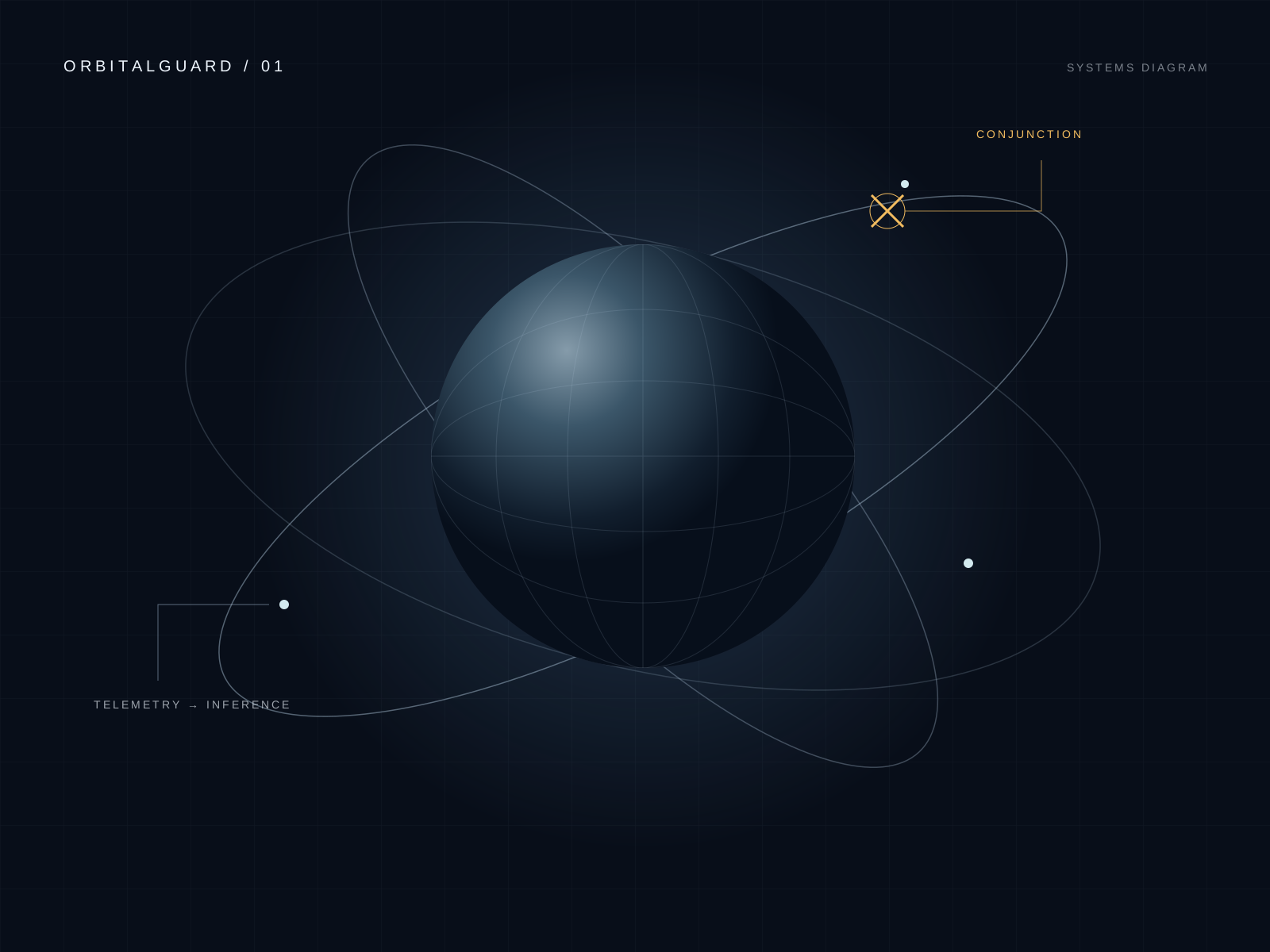
Spacecraft share an increasingly busy neighbourhood. OrbitalGuard studies close approaches between objects and compares several deep learning approaches for estimating collision risk.
The work benchmarks recurrent, convolutional and Siamese architectures on real conjunction events, with attention to missed high-risk encounters, false alerts and stable training. A companion 3D simulator makes the orbital scenarios easier to explore.
The project includes a 35-page IEEE-format technical report describing the experiments and their trade-offs. Publication is in progress; this entry is a research note, not a published or peer-reviewed paper.
Deep learning / Space systems / Collision-risk modelling